Sunday Classic07.08.2026


Sunday Classic07.08.2026

Originally released: 23rd August 1994
Some records become classics because they arrive exactly when they should and define a moment. Others spend years quietly gathering listeners until the work has found its audience and its place. Grace belongs firmly in the latter camp, an album that has consistently found new admirers long after its auteur had burned so brightly.
Born in California in 1966, Jeff Buckley was the son of the cult singer-songwriter Tim Buckley, although they only met on one occasion in 1974, just a year before Tim died tragically of a drug overdose. Despite the constant comparisons that would follow throughout Jeff’s career - vocally there is something entirely emotional in the timbre that connects the two - he largely avoided his father's catalogue during his formative years, instead immersing himself in a broad and eclectic musical education. After session work in his native California, Buckley moved to New York and his ascendancy was rapid, playing regularly at the lauded Sin-é Café and developing a reputation as one of the city's most captivating live performers. It was during this transformative period that his voice developed. Performing early iterations of his own material, he also worked in traditional folk songs and ambitious reworkings of Leonard Cohen, Van Morrison, Nina Simone, Édith Piaf and even Nusrat Fateh Ali Khan. It was that wild versatility that gained so much attention.
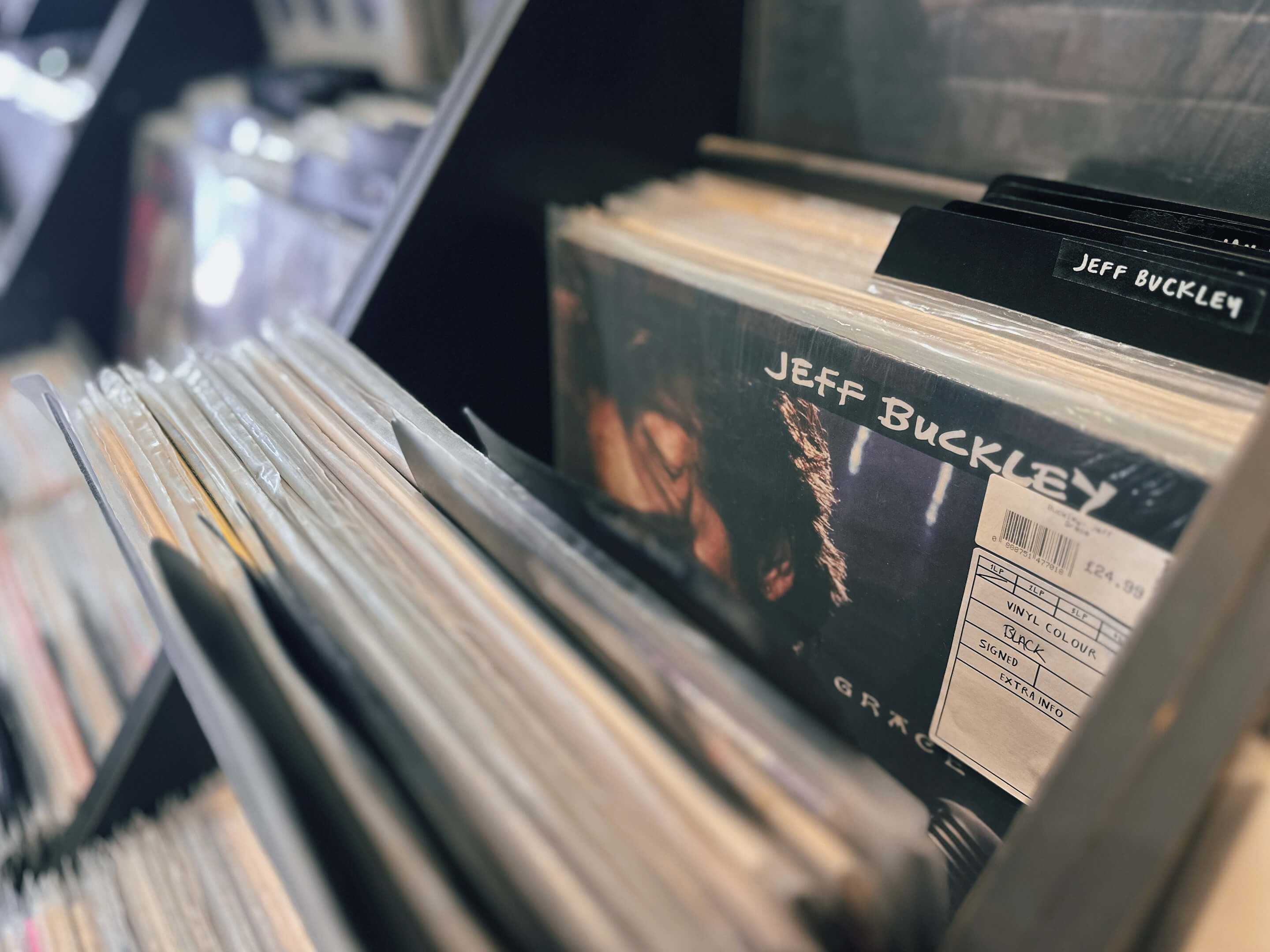
The musical landscape at the time fell somewhere between Britpop and Grunge, with Grace sitting not very close to either. Romantic without sentimentality, technically astonishing without ever feeling too showy and fearless in the breadth of its influences. Considering the production is so immaculate and it was very much a major label record (released on the iconic Columbia Records), Grace is still surprisingly raw, focused on capturing performance more than anything else and all structured around the power and emotion of his voice. Throughout the album sessions, they resisted the temptation to overproduce Buckley's vocals, and rather than stitching together countless takes, many of the performances were used in full, retaining their natural imperfections and preserving the emotional immediacy that defined his live shows.
“When I left Uni I couldn’t think of anything I wanted to do other than work in a record shop. Which was all I wanted to do before I went to Uni too – so could have saved myself 3 years of pain & debt!! I managed to get myself a job at Crawley Our Price & worked with an excellent crew there – many of whom I still get to call friends 30 years on & who still work in the industry one way or another. Soon after joining I asked the shop manager what his favourite album that year had been and without hesitation he told me it was Jeff Buckley’s Grace. I’d seen it but not heard it. I’d definitely judged it by its cover – and wasn’t a fan. But I popped it on the shop stereo the next day and was absolutely blown away.
THAT VOICE!! Those songs. Fragile but visceral. Controlled but wild.
A transformative experience took place on that shopfloor right there and then…and it remains one of my most played records of all time. It still never fails to deliver.”
- Natasha
Considering how influential the album would grow to become (initial sales were surprisingly modest despite widespread critical acclaim), there is still nothing much that sounds anything like it. Grace remains one of those rare records that feels impossible to imitate. From the spectral opening of Mojo Pin to the cathartic release of Dream Brother, Grace rarely sits still. Songs swell and collapse without warning, and it’s only Buckley's extraordinary voice - constantly shifting from an intimate whisper to impossible falsetto - that connects the raw funk-rock of Eternal Life and the tightly wound dramatics of Grace or Last Goodbye. The album is also notable for the way he brought other writers’ work under his spell, with Leonard Cohen’s Hallelujah (although, strictly speaking, Buckley was actually using John Cale's stripped-back piano arrangement as a creative reference), the hymn Corpus Christi Carol, and James Shelton’s jazz standard Lilac Wine all becoming hallmarks of the album’s allure.
Grace was released on 23rd August 1994 and Jeff Buckley tragically drowned just three years later on 29th May 1997. Following his death, as new listeners discovered Grace, its reputation grew exponentially, gradually transforming the album into one of the defining records of the 1990s. There is, inevitably, an added poignancy to listening to the songs, and Buckley's death in 1997 has become inseparable from the album's mythology, but reducing it to tragedy misses the point entirely. The remarkable thing is not that this became his only studio album; it is that someone in their twenties could produce a debut of such confidence and imagination. There are few debut records that sound this fully realised.
A classic and some proper dark magic for your Sunday.


There was an error displaying the form. Please try disabling your ad-blocker.